
Fall in Ottawa means one thing for thousands of families across Kanata and the surrounding communities: hockey is back. Registration at Kanata Minor Hockey has wrapped up, sticks are getting taped, and arenas are filling with the familiar sound of blades on ice. Whether you are a seasoned rep player, a weekend warrior in an adult league, or a parent watching from the stands, this time of year carries real excitement. It also carries real risk, because hockey is one of the most physically demanding sports a person can play, and jumping back into full intensity after a summer off is a recipe for injury if the body is not ready.
At Highlands Wellness, our multidisciplinary sports injury clinic in Kanata, we see a predictable uptick in hockey-related aches, strains, and overuse complaints every September. Our team of chiropractors and registered massage therapists work together to help players of all ages get onto the ice feeling strong and stay there all season long.
Why Hockey Is So Hard on the Body
Hockey asks an enormous amount of the body. The skating stride alone requires repeated, forceful hip extension and abduction, which places significant stress on the groin and hip flexors. Add sudden changes of direction, physical contact, repetitive shooting motions, and hours spent in a flexed, forward posture, and you have a sport that challenges the spine, pelvis, and lower extremities in ways that almost no other activity replicates.
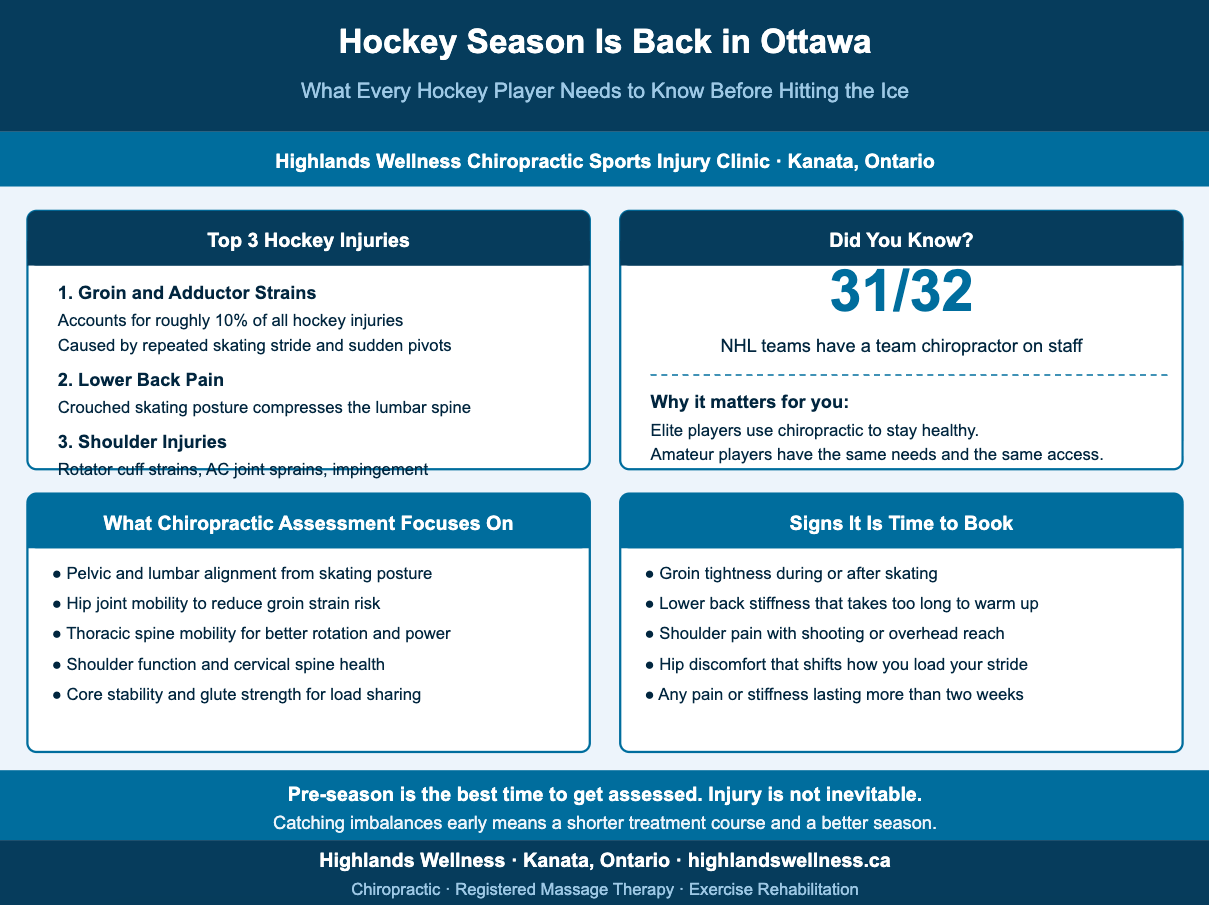
Research has found that groin injuries account for roughly 10% of all hockey-related injuries. Lower back pain and shoulder problems round out the top three, and all three are made significantly worse when players return to the ice without adequate conditioning or with underlying movement restrictions they are not even aware of.
The skating posture itself, that persistent forward lean with bent knees and hips, can create chronic tightness through the hip flexors, thoracic spine stiffness, and weakness in the glutes and deep core. Over time, these imbalances accumulate and show up as pain, reduced performance, or an injury that seems to come out of nowhere.
The Three Injuries Ottawa Hockey Players See Most Often
Groin and Adductor Strains
The adductor muscles on the inner thigh are among the hardest-working muscles in a hockey player's body. Every stride requires them to control the leg as it returns to centre, and the repeated loading across a full season can gradually overwhelm tissue that is not adequately conditioned. Sudden cuts and pivots are often the final straw.
The good news is that adductor strains respond very well to a combination of manual therapy, targeted strengthening, and progressive return to loading. Research on exercises like the Copenhagen Adduction protocol has shown meaningful reductions in groin injury rates when incorporated into pre-season training.
Lower Back Pain
The crouched skating stance can tick off the lumbar spine and keeps the hip flexors in a shortened position for extended periods. Weak glutes and a stiff thoracic spine add to the load on the lower back, and by mid-season many players are carrying a low level of tightness and discomfort that they have simply learned to ignore.
Chiropractic assessment can identify where restricted joint movement and muscle imbalances are contributing to that pattern, and treatment can address the problem rather than just managing the symptom.
Shoulder Injuries
Shoulder contact, falls, and the demands of shooting and puck-handling make the shoulder complex vulnerable throughout the season. Rotator cuff strains, AC joint sprains, and shoulder impingement are all common presentations. Restoring full shoulder mobility and rebuilding rotator cuff strength are key to getting a player back at full capacity, and to making sure the injury does not become a recurring problem.
How Chiropractic Care Fits Into Your Hockey Season
Chiropractic care has become a standard part of elite hockey. At least 31 of the 32 NHL teams now have a team chiropractor on staff, and the reason is straightforward: keeping joints mobile, muscles balanced, and the nervous system functioning well translates directly into better performance and fewer injuries.
At Highlands Wellness, chiropractic assessment for hockey players focuses on a few key areas:
Pelvic and lumbar function. Skating mechanics are hard on the SI joints and lumbar spine. Adjustments restore movement where it has been lost, taking pressure off the structures that tend to get irritated over a long season.
Hip mobility. Restricted hip joint mobility is one of the leading contributors to groin strain and lower back pain in hockey. Restoring full range of motion in the hips changes how load is distributed throughout the stride.
Thoracic spine mobility. A stiff upper back forces the lower back and shoulders to compensate, which is a setup for overuse injuries. Improving thoracic rotation also improves the power and mechanics of a player's shot.
Shoulder function. Assessing the interplay between the cervical spine, thoracic spine, and shoulder girdle often reveals the source of persistent shoulder pain that has not responded to rest alone.
Our team provides the tols to build strength and movement capacity that keeps the gains from manual therapy in place throughout the season.
Pre-Season Is the Best Time to Come In
If you are a hockey player in the Ottawa or Kanata area, the weeks before your first game are the single most valuable time to get assessed. A pre-season visit gives us the chance to identify any movement restrictions or muscle imbalances before they become injuries, and to give you a targeted warmup and strengthening routine to use throughout the season.
Think of it as a tune-up before the mileage starts accumulating.
That said, it is never the wrong time to address a problem that is already developing. If you are carrying tightness in your groin, a nagging lower back, or a shoulder that does not feel quite right, those are worth addressing now, early in the season, before they become something that keeps you off the ice.
Signs It Is Time to Book an Appointment
Come and see us if you notice any of the following:
Groin tightness or a pulling sensation during or after skating
Lower back stiffness that takes longer than usual to warm up
Shoulder pain with reaching, overhead movements, or shooting
Hip discomfort that shifts how you are loading your stride
Any pain or stiffness that has been present for more than two weeks
These are not just nuisances. They are signals from your body that something needs attention, and catching them early makes for a much shorter treatment course and a much better season.
You Can Have a Full, Active Season
We take a movement-optimistic approach to care at Highlands Wellness. That means we focus on building your body's capacity and confidence, not on telling you what you cannot do. The goal of every appointment is to give you better information about what is happening, better tools to manage it, and a clear path back to full activity.
Injury is not inevitable. Most hockey-related injuries are preventable or manageable when they are identified and addressed early, with the right combination of manual therapy, education, and progressive rehabilitation.
Ready to start the season strong? The team at Highlands Wellness in Kanata would love to help. Book an appointment today at highlandswellness.ca or call us to get started.
Related links:
