
You reach up to grab something from a high shelf and feel a sharp twinge. You wake up at 3 a.m. unable to find a comfortable position. You try to swing a golf club or prune the roses and notice that ache in your shoulder has come back again.
If this sounds familiar, you're not alone. Shoulder pain is one of the most common musculoskeletal complaints among adults over 40, and the rotator cuff is usually at the heart of it. The reassuring news: most shoulder pain responds extremely well to conservative care, and you don't need to simply live with it or rush into surgery to feel better.
At Highlands Wellness in Kanata, our multidisciplinary team of chiropractors, registered massage therapists, and exercise rehabilitation specialists works with active adults and older patients every week who come in frustrated by persistent shoulder pain. Here's what we want you to know.
What Is the Rotator Cuff (and Why Does It Keep Coming Up)?
The rotator cuff is a group of four muscles and their tendons that wrap around the shoulder joint. Together, they hold the ball of the upper arm bone securely in the socket and allow you to lift, rotate, and reach in every direction. It's a remarkable structure, but it does have a weak point: a relatively narrow space where the tendons pass under a bony arch at the top of the shoulder.
Over time, repeated overhead movements, poor posture, or simply the gradual changes that come with age can irritate the tendons in that tight space. This leads to the most common shoulder conditions in middle-aged and older adults: rotator cuff tendinopathy (irritated tendons), shoulder impingement, and rotator cuff tears (which range from small partial tears to full thickness).
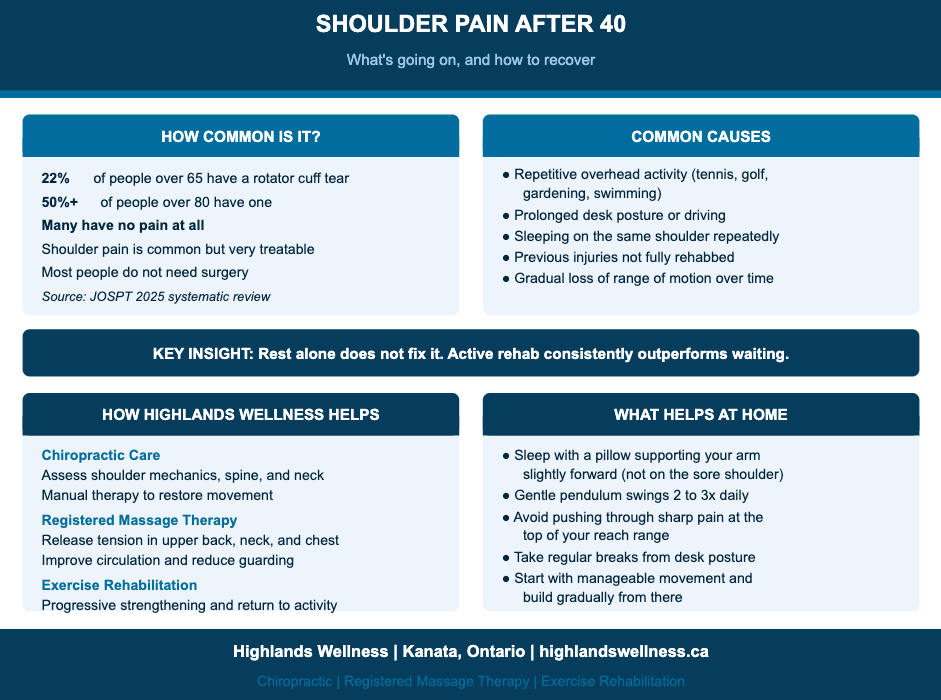
Here's a fact worth sitting with: studies using imaging have found that roughly 22% of people over 65 have a full rotator cuff tear, and more than 50% of people over 80 do too. Many of these people have little to no pain. This is important because it tells us that what shows up on a scan is not always the whole story, and that our bodies are far more resilient and adaptable than we often give them credit for.
Common Causes in the Over-40 Crowd
Rotator cuff problems rarely come from one single dramatic moment (though that does happen). More often, they build up from:
Repetitive overhead activity: tennis, swimming, golf, home repairs, gardening
Sustained poor posture at a desk or while driving
Sleeping on the same shoulder night after night
A gradual reduction in the shoulder's range of motion that goes unaddressed
Previous injuries that were never fully rehabbed
If you've been more active than usual this summer, whether that means paddling, yard work, or finally getting back on the golf course, it's not unusual to notice shoulder discomfort showing up in late August as the accumulated load catches up with you.
Why Rest Alone Doesn't Fix It
One of the most common mistakes people make with shoulder pain is resting completely and hoping it goes away on its own. For mild strains, rest helps short-term. But for most rotator cuff problems, prolonged inactivity leads to stiffness, muscle loss, and a shoulder that becomes even more painful and restricted over time.
The current evidence is clear: active rehabilitation, not passive rest, is the gold standard for rotator cuff recovery. This doesn't mean pushing through sharp pain. It means gradually reintroducing movement, restoring strength and coordination, and giving the shoulder the load it needs to heal and adapt.
This is the framework we use at Highlands Wellness. Rather than telling patients to stop everything, we help them understand what's happening, find the movements that feel safe right now, and progressively rebuild from there. Education, manual therapy, and guided exercise together consistently outperform a "wait and see" approach.
How Chiropractic Care Helps
A chiropractor's role with shoulder pain isn't just about cracking joints. A thorough assessment looks at how the shoulder blade moves, how the upper back (thoracic spine) is contributing, and whether any neck involvement is referring pain into the shoulder region. All of these factors matter.
Manual therapy techniques, including joint mobilization, soft tissue work, and targeted adjustments to the spine or shoulder girdle, can reduce pain and restore movement mechanics that have become restricted. This creates a better environment for the surrounding muscles to do their job again.
For patients in Kanata and the Ottawa area dealing with shoulder impingement, tendinopathy, or early-stage frozen shoulder, chiropractic care combined with a progressive exercise program has strong research support. A 2024 systematic review found that patients receiving chiropractic care for shoulder pain showed significant improvements in pain and function within four to six weeks.
The Role of Registered Massage Therapy
Shoulder pain almost always involves muscle tension and guarding that builds up around the injured area. The muscles of the upper back, neck, and chest tighten as the body tries to protect the shoulder, and over time this tension becomes its own source of pain and limitation.
Registered massage therapy directly addresses this layer of the problem. By releasing the surrounding musculature, improving circulation to the area, and reducing the nervous system's threat response, massage therapy helps the shoulder move more freely and makes the work done in chiropractic and exercise rehab more effective.
At Highlands Wellness, our chiropractors and RMTs work as a coordinated team rather than in silos. This means your care plan makes sense as a whole, not just as a collection of separate appointments.
Practical Steps You Can Take Right Now
While you're getting assessed and starting treatment, a few simple strategies can help:
Sleep position: Avoid sleeping directly on the affected shoulder. Placing a pillow in front of you and resting the arm on it in a slightly forward position often reduces nighttime pain significantly.
Avoid overhead reaching at the end of range: You don't need to avoid using your arm, but pushing through sharp pain at the top of a reach repeatedly will keep the irritation cycle going. Find the range that feels manageable and work from there.
Keep the shoulder moving gently: Gentle pendulum exercises (letting the arm hang and swing slowly in small circles) promote circulation and movement without loading the joint. Two to three minutes a few times daily is a great starting point. This should be progressed with your practitioner to get to a weight-bearing and strong position.
Address your posture: A rounded upper back and forward head posture directly compress the space the rotator cuff tendons pass through. Small postural adjustments, regular breaks from sitting, and some thoracic mobility work can make a meaningful difference.
When to Come In
If your shoulder pain has persisted for more than two weeks, is waking you at night, or is limiting your daily activities, it's time to get it properly assessed. The sooner you understand what's actually driving the pain, the sooner you can start addressing it effectively.
You don't need a referral to see a chiropractor, and your first appointment at Highlands Wellness will include a full assessment so we understand your specific situation before recommending anything.
You Don't Have to Just Live With It
Shoulder pain is common, but common doesn't mean inevitable, and it definitely doesn't mean permanent. With the right care approach and a gradual return to the activities you love, most people with rotator cuff problems make a full and lasting recovery.
If you're in the Kanata or Ottawa area and you're ready to stop guessing and start getting real answers, our team at Highlands Wellness is here to help.
Book an appointment online or call us today. We'll figure out what's going on and build a plan that gets you moving again.
Related links:
Sources:
Rotator Cuff Imaging Abnormalities in Asymptomatic Shoulders: JOSPT
Shoulder Pain After 40: New Research, Real Answers, and When to Get Help
Highlands Wellness is a multidisciplinary sports injury clinic in Kanata, Ontario, offering chiropractic care, registered massage therapy, and exercise rehabilitation.
