
Golf and Low Back Pain: How Kanata Golfers Can Keep Swinging All Summer
It is a perfect July morning in Kanata. You are three holes into your round when you feel it: that familiar tightness creeping into your lower back. By the back nine you are shortening your swing, and by the time you load the clubs into the car you are already wondering whether you should skip next week's round.
If that sounds like you, you are in good company. Low back pain is the single most common complaint in golf, accounting for up to half of all golf injuries. Research suggests roughly 25 to 36 percent of male golfers and 22 to 27 percent of female golfers deal with low back pain, and once it shows up, it tends to come back.
Here is the good news, and it is the message we share with every golfer who walks into Highlands Wellness, our multidisciplinary sports injury clinic in Kanata: a sore back does not mean your golf season is over, and it almost never means golf is "bad for your back." Your back is strong, adaptable, and built to move. With the right plan, most golfers can keep playing while they recover.
Why Golfers Get Low Back Pain
The golf swing is one of the most athletic movements in sport. In under two seconds, you rotate your spine at high speed, generate force from the ground up, and decelerate all of that energy on your lead side. Then you do it 80 to 100 times per round, plus practice swings.
A few common contributors show up again and again:
Doing too much, too soon. The most common story we hear in Ottawa is the spring and early summer spike: after a long winter off, golfers jump from zero rounds to three rounds a week plus range sessions. The issue usually is not the swing itself. It is asking your back to handle more load than it is currently prepared for.
Skipping the warm up. Research shows golfers who do not warm up properly are more likely to report injury, and a randomized controlled trial found a structured warm up program significantly reduced low back pain incidents in golfers.
Low overall strength and rotation capacity. Your swing borrows rotation from your hips and mid back. If those areas are stiff or deconditioned, your lower back often picks up the slack.
Long stretches of sitting before you play. Driving to the course after a full day at a desk, then stepping straight onto the first tee, is a recipe for a cranky back.
Notice what is not on that list: a "damaged" spine. For the vast majority of golfers, back pain is a sensitivity and capacity problem, not a structural one. That distinction matters, because it changes the goal from protecting your back to preparing it.
Movement Is the Medicine, Not the Enemy
There is an outdated idea that a sore back needs rest, bracing, and caution. Modern musculoskeletal research points the other way. Backs get healthier when they are gradually loaded, moved often, and trusted again.
This is the movement optimism approach we use at Highlands Wellness. In practice, it means three things for golfers:
We calm things down. Hands on care like joint mobilization, manual therapy, and registered massage therapy can reduce pain and muscle guarding so you can move more comfortably in the short term.
We build things back up. Our exercise rehabilitation specialists design a progressive program that restores hip and mid back rotation, core strength, and the specific capacity your swing demands.
We keep you in the game. Complete rest is rarely the answer. We would rather modify your golf, perhaps fewer holes, a smoother tempo, or a cart for a few weeks, than pull you off the course entirely.
Golfers who understand their pain and stay active recover with more confidence, and they are far less fearful the next time their back grumbles. Feeling empowered, not fragile, is the outcome we care about most.
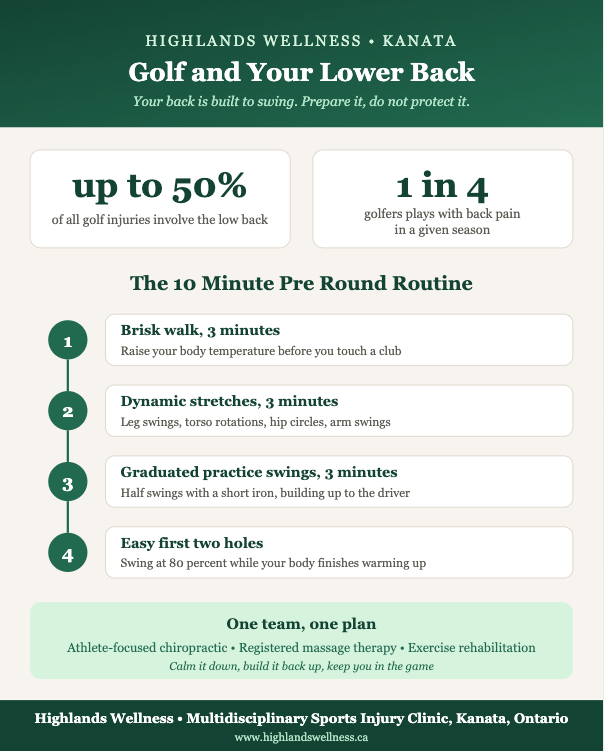
A Simple Pre Round Routine for Ottawa Golfers
You do not need 45 minutes in a gym before your tee time. Ten minutes is enough to meaningfully lower your risk. Try this before your next round at any of the courses around Kanata.
Brisk walk, 3 minutes. Park farther away or loop the practice green. Raising your body temperature is the foundation of any warm up.
Dynamic stretches, 3 minutes. Leg swings, torso rotations, hip circles, and arm swings. Research favours dynamic movement over long static stretching before sport.
Graduated practice swings, 3 minutes. Start with half swings at half speed with a short iron, and build gradually to full speed with your driver.
First tee strategy, 1 minute. Swing at 80 percent for the first two holes. Think of them as the final stage of your warm up.
Between rounds, two short strength sessions a week focused on hips, core, and mid back rotation will do more for your back, and your driving distance, than any gadget or brace.
When Should You Get Help?
Most flare ups settle within days to a couple of weeks. It is worth booking an assessment if your pain lingers beyond two weeks, keeps returning every few rounds, travels into your buttock or leg, or has you avoiding golf altogether.
At Highlands Wellness in Kanata, our team of chiropractors focused on athletes, registered massage therapists, and exercise rehabilitation specialists work together under one roof. That means your assessment, hands on treatment, and rehab plan all talk to each other, and everything is aimed at one goal: getting you back to the golf you love, with a back that is more capable than before.
Keep Your Season on Track
Golf season in Ottawa is short enough already. You should not have to give away rounds to a back that just needs the right plan.
If back pain is creeping into your game, we would love to help. Book an assessment at our Kanata clinic, or reach out with questions anytime. No pressure, no scare tactics, just a clear plan to keep you swinging.
Book an appointment at Highlands Wellness in Kanata
Related Links
Sources
Golf related lower back injuries: an epidemiological survey (PMC)
Golf related low back pain: a review of causative factors and prevention strategies (PMC)
Musculoskeletal complaints in 1170 male golfers, cross sectional study (PMC)
Warm up program for golfers reduces low back pain, randomized controlled trial (PMC)
