
Pickleball Injuries in Ottawa: How to Recover and Play Your Best Game
You woke up this morning feeling great about yesterday. You played three sets of pickleball at Walter Baker Park, held your own against players half your age, and walked off the court feeling like you could do it all again tomorrow. Then you reached for your coffee and felt it — that sharp, burning pull along the outside of your elbow.
Sound familiar? You are not alone.
Pickleball is one of Canada's fastest-growing sports, and Ottawa's west end has fully embraced it. Between the courts at Kanata recreation centres and the brand-new dedicated facilities in our area, more people than ever are swinging paddles, pivoting hard on hard surfaces, and returning Monday morning a little sorer than they expected. At Highlands Wellness in Kanata, we are a multidisciplinary sports injury clinic with chiropractors, registered massage therapists (RMTs), and exercise rehabilitation specialists working together under one roof. We see a lot of pickleball players. And the first thing we want you to know is this: getting hurt does not mean you are broken.
Why Pickleball Injuries Are on the Rise in Ottawa
Pickleball's appeal is exactly what makes it tricky on the body. It is accessible enough for almost anyone to pick up and intense enough to challenge athletes who have been training for decades. That combination means people often ramp up their load faster than their tissues are ready for.
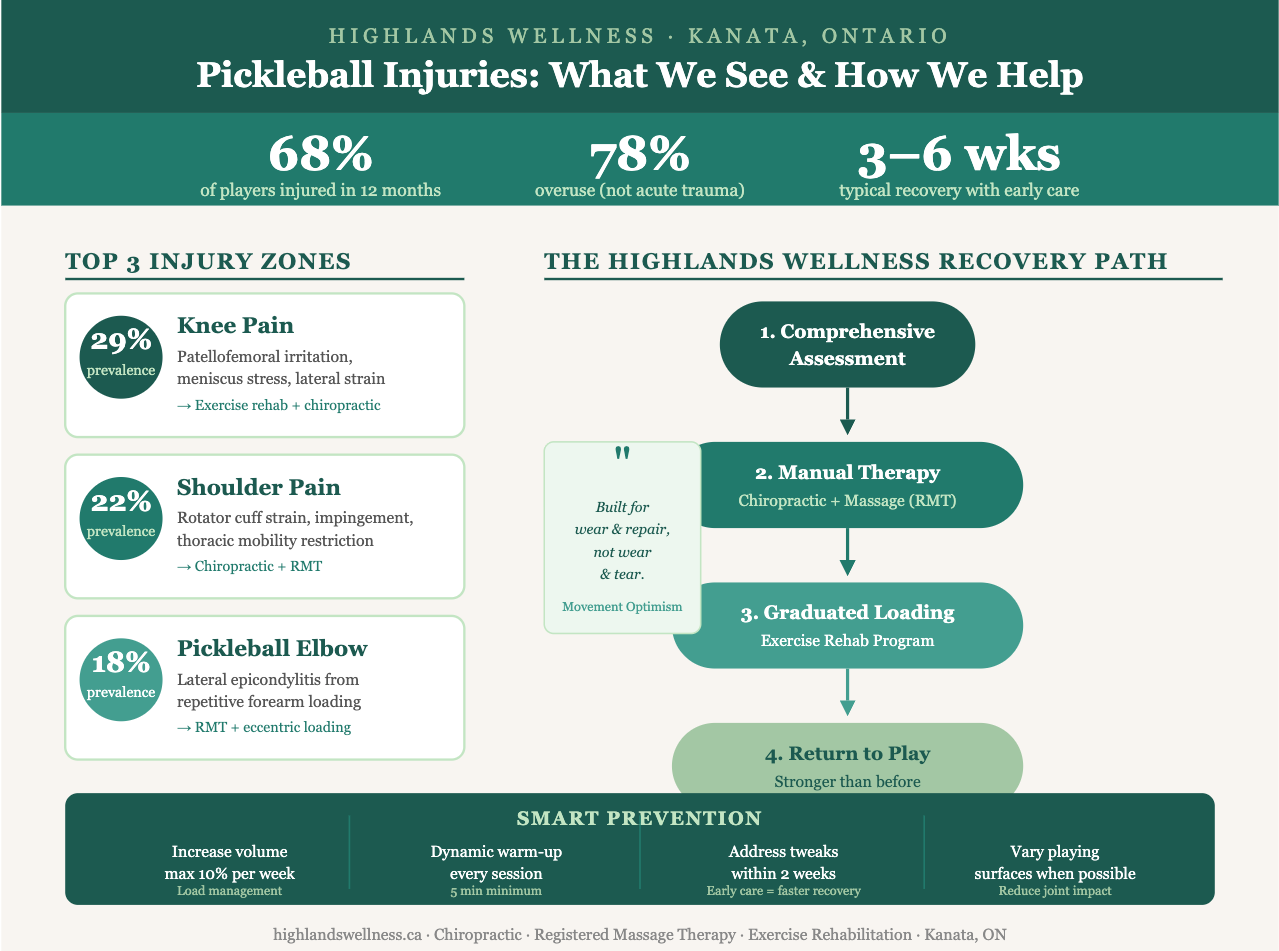
A 2025 nationwide study published in Sports Medicine Open found that 68.5% of pickleball players reported at least one injury in a 12-month period, with overuse injuries accounting for 78% of all cases. These are not freak accidents. They are the predictable result of repetitive stress on tissues that have not had time to adapt.
In Ottawa and Kanata specifically, the sport's year-round availability (indoor leagues run all winter) means people rarely give their bodies a full off-season to rebuild. Add hard court surfaces, quick lateral cuts, and the overhead smash motion, and you have a recipe for predictable, treatable, and highly preventable injuries.
The Most Common Pickleball Injuries We Treat at Highlands Wellness
Pickleball Elbow (Lateral Epicondylitis)
This is the big one. A 2026 study in the Journal of Orthopaedic & Sports Physical Therapy found that the shoulder and elbow are the most commonly injured upper-body regions in pickleball, with elbow injuries affecting roughly 18% of players surveyed. The repetitive wrist snap and forearm rotation involved in dinking and driving puts sustained load through the lateral elbow tendons.
The pain tends to start as a mild ache and builds gradually. Many players try to push through it, which often delays recovery. The good news: this responds extremely well to a combination of manual therapy, targeted loading exercises, and technique coaching. You almost certainly do not need to stop playing entirely.
Knee Pain and Meniscus Irritation
The knee is actually the single most commonly injured region in pickleball, appearing in roughly 29% of injury reports in recent research. The non-dominant side takes a surprising amount of torque during lateral movements and the low athletic stance the game demands. We frequently see patellofemoral (kneecap) irritation and medial knee pain at Highlands Wellness.
Exercise rehabilitation is central to knee recovery. Strengthening the glutes, quads, and hips reduces the load the knee has to absorb on every pivot, and most patients see meaningful improvement within four to six weeks of structured rehab.
Shoulder Impingement and Rotator Cuff Strains
At 22% prevalence in upper-body surveys, shoulder pain is the third major complaint we see in our pickleball players. The overhead smash is the usual culprit. Poor thoracic mobility (stiffness through the mid-back) often contributes because the shoulder compensates when the spine cannot rotate fully. This is where chiropractic care and RMT work beautifully together: manual therapy to restore movement through the thoracic spine, and soft tissue work to release the muscles around the shoulder girdle.
Your Body Is More Resilient Than You Think
Here is something we want every patient to understand before they start worrying about an MRI or a diagnosis: tissue pain does not mean tissue damage. This is a core principle in the approach developed by clinician-researchers like Dr. Greg Lehman and Dr. Craig Liebenson, whose work on movement optimism and load management has shaped how evidence-based clinicians now think about sport injury.
The body is not built for "wear and tear." It is built for wear and repair. When a tendon or muscle is overloaded, it sends pain signals as a warning that the load exceeds its current capacity. The solution is not always rest. It is usually a graduated increase in load that teaches the tissue to handle more over time.
This means the goal at Highlands Wellness is never just to get your pain down. It is to build you back up so you can handle more than you could before the injury. That is what empowers people to return to sport with confidence instead of anxiety.
How Our Highlands Wellness Team Treats Pickleball Injuries
Our approach combines three disciplines because pickleball injuries rarely have a single cause.
Chiropractic care addresses joint mobility throughout the kinetic chain, from the wrist and elbow up through the shoulder, neck, and thoracic spine. Restrictions anywhere in that chain change how load is distributed and can contribute to tissue overuse downstream.
Registered massage therapy (RMT) targets muscle tension, scar tissue buildup, and circulation. For lateral elbow pain especially, instrument-assisted soft tissue work and deep tissue massage to the forearm extensors make a significant difference in how quickly patients progress.
Exercise rehabilitation is where the long-term results happen. Our clinicians help you develop a graduated loading program that starts where your body is and progresses systematically. Eccentric loading for the elbow, hip strengthening for the knee, and rotator cuff integration for the shoulder are evidence-backed approaches we use regularly.
This comprehensive strategy means we can usually get you back on the court faster than any single-modality approach would allow. Many patients continue playing at a modified intensity throughout their recovery rather than sitting out entirely.
Preventing Pickleball Injuries Before They Start
Prevention comes down to one concept: load management. Here are the principles we share with every active patient.
Increase playing volume by no more than 10% per week. Your tendons adapt more slowly than your cardiovascular fitness, so feeling aerobically fresh does not mean your elbows and knees are ready for more.
Vary surfaces when possible. Concrete demands more from the lower body than cushioned sport courts or indoor gymnasium floors.
Invest in a proper warm-up. Five minutes of dynamic movement (leg swings, arm circles, lateral shuffles, and thoracic rotations) reduces your injury risk meaningfully.
Address stiffness early. A twinge that lasts more than two weeks is a signal worth bringing to a clinician. Catching things early shortens recovery time dramatically.
Get Back to the Game You Love
Pickleball is a genuinely wonderful sport. It is social, competitive, and kind to aging bodies in many ways. The injuries are manageable when they are addressed with the right approach.
If you are dealing with elbow soreness, knee pain, or a nagging shoulder, the team at Highlands Wellness in Kanata is here to help. We will look at the whole picture, not just the painful part, and build a plan that gets you back on Ottawa's courts as quickly and confidently as possible.
Book an appointment at Highlands Wellness in Kanata by visiting www.highlandswellness.ca or calling us directly. Whether you are a weekend warrior or a serious competitor, we are here for the long game with you.
Related Pages on Our Website
Sources
Krebsbach, M. et al. (2026). Understanding Upper Extremity Injury Prevalence and Risk in Pickleball Players: A Nationwide Survey. JOSPT Open. jospt.org
Ryu, J. et al. (2025). Understanding Injury Patterns and Predictors in Pickleball Players: A Nationwide Study of 1,758 Participants. Sports Medicine Open. springer.com
Frontiers in Public Health (2025). Injury risk and epidemiology of pickleball players: a cross-sectional study. frontiersin.org
Lehman, G. (2019). The Wedge That Divides: Movement Optimism versus the Kinesiopathological Model. greglehman.ca
Ottawa Pickleball Association. ottawapickleballassociation.com
Highlands Wellness is a multidisciplinary sports injury clinic in Kanata, Ontario, offering chiropractic care, registered massage therapy, and exercise rehabilitation. We help active people move better, recover faster, and stay in the game.
