
IT Band Syndrome: Why Ottawa Runners Get Sidelined — And How to Get Back Out There
You're a few weeks into your fall training block, feeling good, logging solid kilometres and then it hits. A sharp, burning ache on the outside of your knee that shows up around the 5K mark like clockwork. You try to run through it. You stretch. You foam roll. It keeps coming back.
If this sounds familiar, you're likely dealing with IT band syndrome. This is the most common cause of lateral knee pain in runners, and one of the most frustrating injuries to navigate on your own.
The good news: with the right approach, it's highly recoverable. At Highlands Wellness in Kanata, our team of chiropractors, registered massage therapists, and exercise rehabilitation specialists work together to get Ottawa athletes back to running. We don’t stop at just pain-free, we aim for stronger and more resilient.
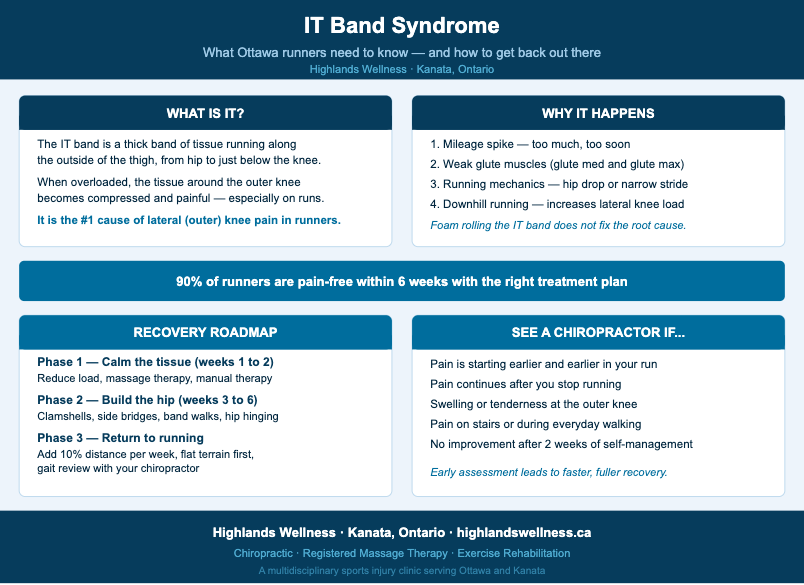
TLDR: this graphic has you covered. The blog is helpful though, so maybe keep reading if you want.
What Is the IT Band, Exactly?
The iliotibial band (IT band or ITB) is a thick band of connective tissue that runs along the outside of your thigh, from your hip down to just below your knee. It's not a muscle, it's a dense fascial structure that stabilizes the knee during running and cycling.
IT band syndrome (ITBS) develops when the tissue around the outer knee becomes irritated and painful. For a long time, clinicians called this a "friction syndrome". The idea was that the IT band rubbed back and forth across a bony prominence on the femur. More recent research has updated that picture: we now understand that compression of the fat pad beneath the IT band is the more likely culprit, not friction.
Either way, the result is the same: a nagging lateral knee pain that often gets worse the longer you run, and disappears when you stop.
Why Does It Happen? (It's Not Just "Tight Hips")
Foam rolling your IT band until it's numb might feel productive, but it's not addressing the root cause. The IT band itself can't meaningfully be "stretched" because it's too thick and anchored at both ends for that.
What the research increasingly points to is a combination of factors:
Training load spikes. The most consistent predictor of ITBS is doing too much, too soon. Ramping mileage quickly, adding hills, or returning to hard training after time off. If you're stepping up your training for the Canada Army Run on September 20 or another fall race, this is the critical window to watch.
Hip muscle weakness. When the glute medius and gluteus maximus are not doing their job, the knee tends to get overworked and cranky (just like us when we’re overworked). In several studies, runners with ITBS showed measurable hip abductor weakness compared to runners without pain.
Running mechanics. Over striding, low step cadence and high weekly volume without adequate recovery can all tick the knee off.
The important takeaway: ITBS isn't a structural problem with your IT band. It's usually a load management problem and that means it responds very well to the right intervention.
The Recovery Roadmap: What Actually Works
Research supports a multi-pronged approach, and it lines up well with what we do at Highlands Wellness.
Phase 1: Calm the Tissue
In the early acute phase, the goal is to reduce irritation. This usually means a short reduction in running volume (not a full stop, unless pain is severe), avoiding activities that reproduce the pain (especially downhill running), and addressing local tissue sensitivity.
Registered massage therapy can play a meaningful role here. Our goal is not to "loosen" the IT band itself, but to address tension in the TFL (tensor fascia latae), glute complex, and lateral quadriceps that may be contributing to increased load at the knee. Manual therapy from a chiropractor or registered massage therapist can also address movement restrictions at the hip and lumbo-pelvic region that are altering how force travels through the leg.
Phase 2: Build the Foundation
This is where the real work happens and where most runners short-circuit their recovery by ramping up running volume too soon.
Targeted hip strengthening is the most evidence-supported intervention for ITBS. In one clinical study, runners placed on a structured hip abductor strengthening program showed a 90% pain-free rate at six weeks. Exercises like side-lying hip abduction, clamshells, lunges, lateral band walks, side bridges, and single-leg hip hinging are foundational.
At Highlands Wellness, our exercise rehabilitation specialists build individualized programs that progress from basic hip stability work through to running-specific loading so the exercises you do in clinic actually translate to what your body needs on the trail.
Phase 3: Return to Running Intelligently
Returning to running too fast is the most common reason ITBS recurs. A structured return-to-run protocol — gradually increasing distance by no more than 10% per week, avoiding hills early, and monitoring for the return of symptoms — gives the tissue time to adapt without being overloaded again.
Your chiropractor can help assess your running gait and identify any movement patterns worth adjusting. Even small changes in stride length or cadence can meaningfully reduce knee pain.
How Long Does IT Band Syndrome Take to Heal?
With appropriate management, most runners see meaningful improvement within two to four weeks. Full resolution — especially for chronic or recurrent cases — can take six to eight weeks or longer.
The 91.7% full recovery rate at six months in research studies reflects what we see clinically: nearly everyone with ITBS gets better. The variable is usually whether they got the right guidance early, or spent months trying things that weren't working.
Warning Signs You Shouldn't Run Through
IT band syndrome can usually be managed through modified activity rather than complete rest. But a few signs should prompt you to get assessed sooner rather than later:
- Pain that starts earlier and earlier in your run (e.g., now at 1K instead of 5K)
- Pain that continues after you've stopped running
- Swelling or significant bruising around the outer knee
- Pain at rest or during everyday activities like walking downstairs
These patterns suggest the tissue needs more support than self-treatment alone can provide.
Treat the Knee. Train the Hip. Run Smarter.
IT band syndrome is one of those injuries that can feel like it owns you — until you understand what's actually driving it. It's not a structural flaw. It's a mismatch between what your body is being asked to do and what it's currently capable of. Close that gap, and most runners are back on the road feeling better than before.
If you're dealing with outer knee pain in the Ottawa or Kanata area and want to figure out what's actually going on, our team at Highlands Wellness is here to help. We combine chiropractic care, registered massage therapy, and exercise rehabilitation under one roof — so you get a complete picture, not just a piece of the puzzle.
Book an appointment at our Kanata clinic — we'd love to help you get back to the running you love.
Book Online at Highlands Wellness
Related Resources
Highlands Wellness — Sports Injury Care in Kanata
Chiropractic Care to Treat & Prevent Sports Injuries — Canadian Chiropractic Association
A Review of Treatments for Iliotibial Band Syndrome in the Athletic Population — NIH/PMC
Effects of Conservative Treatment Strategies for ITBS — Frontiers in Sports and Active Living (2024)
