
Massage Therapy for Stress in Ottawa: More Than Just a Treat
You know that feeling when the back-to-school scramble kicks in, the work calendar fills up again, and your shoulders seem to climb toward your ears without you noticing? Or you wake up after a full night of sleep and still feel like you never quite switched off?
Stress is one of the most common things people bring into our clinic at Highlands Wellness in Kanata. And one of the most underused tools for managing it is registered massage therapy (RMT).
Many people still think of massage as a luxury, something you do on a spa day or a birthday treat. That perception undersells what a skilled registered massage therapist actually does. At our multidisciplinary clinic, our RMTs work alongside chiropractors and exercise rehabilitation specialists to address the physical effects of stress in a real, evidence-informed way.
Here is what is actually happening in your body when stress builds, and why massage therapy is one of the most effective ways to address it.
What Stress Actually Does to Your Body
Stress is not just a feeling. It is a full-body physiological response.
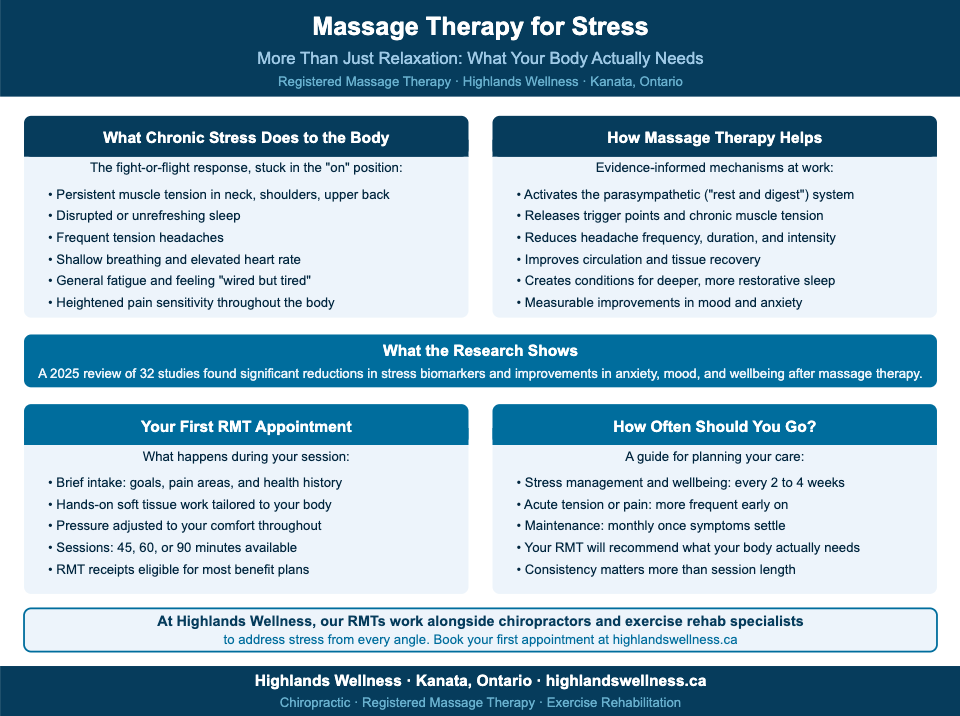
When you are under pressure, your nervous system activates what is called the "fight-or-flight" response. Your body releases stress hormones, your muscles tighten, your heart rate rises, and your breathing gets shallow. In short bursts, this is normal and useful. But when stress is chronic, those responses become constant background noise.
Over time, chronic stress leads to persistent muscle tension (especially through the neck, shoulders, and upper back), disrupted sleep, frequent headaches, fatigue, digestive issues, and a general sense of being stuck in overdrive.
The goal is not to eliminate stress from your life. It is to give your body the tools to recover from it.
How Massage Therapy Helps
Shifting Your Nervous System
One of the most important things massage does is activate the parasympathetic nervous system, often called the "rest and digest" system. This is the counterpart to the fight-or-flight response. When the parasympathetic nervous system is engaged, your heart rate slows, your breathing deepens, and your muscles begin to let go.
This is not just a pleasant feeling. It is a measurable physiological shift. Studies show that even a single massage session can produce meaningful reductions in heart rate and improvements in mood and sense of calm.
Releasing Muscle Tension
Chronic stress parks itself in your muscles. The tension you carry in your jaw, your trapezius, your neck, your lower back — a lot of that is accumulated stress, not just the result of poor posture or overuse.
Your registered massage therapist can identify areas of tension and restriction, work through them systematically, and help your body release what it has been holding. This is different from simply "relaxing." It is hands-on therapeutic work that addresses the physical pattern stress creates.
Reducing Headaches
Tension-type headaches are one of the most common complaints associated with chronic stress. They often start in the neck and upper back and spread upward. Massage therapy has been shown to reduce headache frequency, duration, and intensity by releasing trigger points, improving circulation, and addressing the muscle tension at the root of the problem.
If you have been dealing with regular headaches, it is worth looking at what your body is holding rather than just managing the pain when it shows up.
Supporting Better Sleep
Poor sleep and stress are tightly linked. Stress makes it harder to fall asleep and harder to stay there, and poor sleep makes it harder to manage stress. It is a cycle that is difficult to break through willpower alone.
Massage therapy helps by calming the nervous system, reducing physical discomfort, and creating the conditions your body needs to move into genuine rest. Many patients at our Kanata clinic report that the nights after an RMT session are among their best sleep in weeks.
What to Expect at Your First Massage Therapy Appointment
If you have never seen a registered massage therapist before, it helps to know what to expect.
Your RMT will start with a brief intake conversation to understand where you are holding tension, any areas of pain or discomfort, and what your goals are for the session. There is no one-size-fits-all approach. A therapeutic massage session is adapted to your body and your needs, not a scripted routine.
Treatment typically involves hands-on work to the soft tissues of the body: muscles, connective tissue, and surrounding structures. Pressure is adjusted based on your feedback. You are always in control.
Sessions at Highlands Wellness are typically 45 to 60 minutes, though 75-minute appointments are available for those who want a more comprehensive treatment.
How Often Should You Go?
This depends on what you are dealing with. For stress management and general wellbeing, many people find that a session every two to four weeks helps them maintain a baseline where they feel more resilient and less reactive. For acute tension or pain, more frequent appointments in the early weeks can help move things along more quickly.
Your RMT will give you honest guidance based on how your body responds. We are not in the business of recommending appointments you do not need.
Massage Therapy as Part of a Bigger Picture
At Highlands Wellness, we think about stress and recovery as team sports. Our chiropractors can address the mechanical patterns that stress reinforces (forward head posture, rounded shoulders, restricted thoracic movement). Our team can help you build the physical resilience and movement habits that make your body better equipped to handle demanding seasons. And our registered massage therapists work on the soft-tissue side of the equation, helping your nervous system find its way back to baseline.
None of this requires you to be in serious pain to benefit. If you have been feeling tight, exhausted, or wound up, that is enough of a reason to come in.
Ready to Feel Like Yourself Again?
If stress has been showing up in your body as tension, headaches, poor sleep, or that constant feeling of being on edge, massage therapy is a genuinely effective way to address it, not just mask it.
Our registered massage therapists are welcoming new patients at our Kanata clinic. We would love to help you find your way back to feeling well.
Book an appointment at Highlands Wellness at highlandswellness.ca or give us a call at 613 501 2853. You deserve to feel good.
