
Why Your Headaches Might Be Coming From Your Neck (And What You Can Do About It)
It usually shows up late in the day. You have been at your desk since morning, or maybe you just finished the two hour drive back from the cottage, and there it is: a dull, squeezing ache that starts at the base of your skull and creeps up behind your eyes. You reach for the usual pain reliever, but by now you have probably wondered whether something else is going on.
Here is something many people are surprised to learn: a large share of stubborn headaches do not start in the head at all. They start in the neck.
At Highlands Wellness, our multidisciplinary sports injury clinic here in Kanata, this is one of the most common things we see, and not just in athletes. Our team of chiropractors and registered massage therapists work with desk workers, busy parents, athletes and retirees who all share the same story: tight neck, tired shoulders, and headaches that keep coming back. The good news is that neck related headaches respond well to hands on care and movement, and there is a lot you can do about them.
The Neck and Headache Connection, Explained Simply
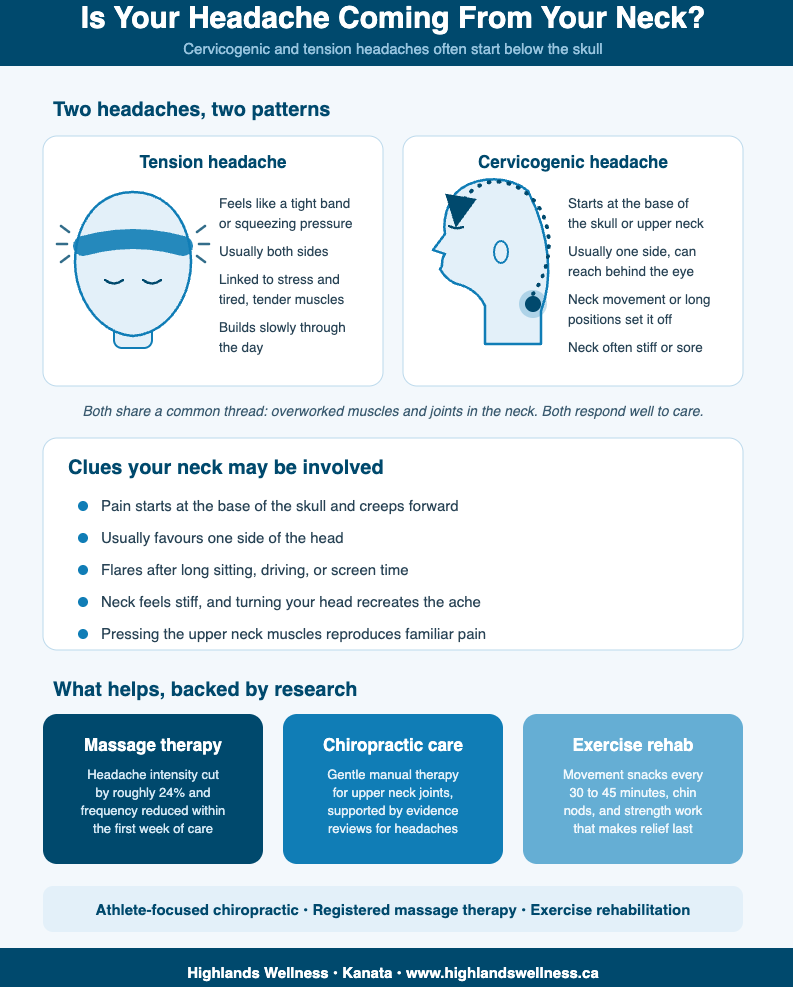
Your upper neck and your head share nerve pathways. When the joints and muscles of the upper neck become irritated or overloaded, that irritation can be felt as pain in the head. Clinicians call this a cervicogenic headache, which is just a technical way of saying a headache generated by the neck.
Tension type headaches, the most common headache in the world, are close cousins. They often involve sensitive, overworked muscles in the neck, shoulders, and scalp. Research suggests headaches affect nearly half of the global population, and neck pain itself is remarkably common, with one large American study estimating that over half of adults deal with it.
A few clues suggest your neck may be involved:
The pain starts at the base of the skull or in the neck before spreading forward
It tends to favour one side of the head
It flares up after long periods of sitting, driving, or screen time
Your neck feels stiff, or turning your head reproduces the ache
Pressing on the muscles at the top of your neck recreates familiar pain
Why Summer in Ottawa Can Stir These Headaches Up
You might expect neck trouble to be a winter problem, but Summer has its own triggers. Long weekend drives to the cottage keep your head fixed in one position for hours. Lounging with a phone or a paperback on the dock puts your neck in a deep forward bend. And plenty of us are still logging full work days at a screen between those getaways.
Posture research gives a helpful picture here. Your head weighs roughly 10 to 12 pounds in a neutral position, but as it drifts forward and down toward a phone, the effective load on your neck climbs steeply, reaching an estimated 40 to 60 pounds at deeper angles. Your neck is strong and adaptable, so this is not dangerous. It is simply a lot of sustained work for muscles that never get a break, and tired, irritated muscles are exactly what feed tension and cervicogenic headaches.
The Movement Optimism Take: Your Neck Is Not Fragile
Here is where we differ from a lot of what you will read online. Your neck is not damaged, out of place, or doomed by your posture. Necks are robust. The problem is rarely one bad position and almost always a lack of variety: too much of the same position, for too long, too often, in a body that is asking for movement.
That reframe matters because fear makes pain worse. When people believe their spine is fragile, they brace, guard, and move less, and the stiffness and sensitivity grow. When they understand their neck is strong and trainable, they move more freely and usually feel better faster. This is the philosophy that guides everything we do at our Kanata clinic: calm things down, build things back up, and help you trust your body again.
How Massage Therapy Helps Neck Related Headaches
Registered massage therapy is one of the most effective ways to settle the muscular side of these headaches. Research on tension type headaches found that regular massage reduced how often headaches showed up, with one study seeing frequency drop significantly within the first week of treatment. Another trial found head and neck massage reduced headache intensity by roughly 24 percent, far more than the placebo comparison.
Our RMTs focus on the muscles that most often refer pain into the head, including the upper trapezius, the suboccipitals at the base of the skull, and the muscles along the side of the neck. Beyond the hands on work, treatment gives your nervous system a powerful signal of safety and ease, which is often exactly what a sensitized, headache prone system needs.
Where Chiropractic Care and Exercise Rehab Fit In
Massage settles the soft tissue, and chiropractic care addresses the joint side of the equation. Gentle, targeted manual therapy for the upper back and neck can improve how those joints move and feel, and evidence reviews support manual therapy as a helpful option for both cervicogenic and tension type headaches.
Then comes the part that makes results last: movement. Our chiropractors coach simple, progressive exercises that build endurance in the deep neck muscles and strength through the shoulders and upper back. A few practical habits you can start today:
Take a movement snack every 30 to 45 minutes: stand, roll your shoulders, and turn your head each way a few times
Raise your screen or phone toward eye level rather than dropping your head to it
On long drives, adjust your headrest, and stop every hour or so to walk and reset
Try slow chin nods: gently nod as if saying yes with just the top of your neck, 10 times, a few times per day
Stay generally active, because regular exercise is one of the best headache preventers we know of
When to Get It Checked
Most neck related headaches are stubborn but not sinister. That said, see a health professional promptly for a sudden severe headache unlike any you have had, a headache after significant trauma, or one accompanied by fever, vision changes, weakness, or numbness.
For the everyday variety, the ones that keep tagging along after desk days and cottage drives, you do not have to keep white knuckling through them. An assessment can identify whether your neck is driving the problem and map out a plan that combines massage therapy, chiropractic care, and exercise so you improve and stay improved.
Ready to Get Ahead of Your Headaches?
If headaches have been shadowing your summer, we would love to help. Our team at Highlands Wellness in Kanata offers registered massage therapy, athlete focused chiropractic care, and guided exercise rehabilitation under one roof, and we serve families and active adults from across the Ottawa area. Book an assessment or a massage therapy appointment at www.highlandswellness.ca, or get in touch with any questions. Your neck is stronger than you think, and relief is closer than you might expect.
Related Reading from Highlands Wellness
Golf and Low Back Pain in Kanata: How Kanata Golfer’s Can Keep Swinging All Summer
Cycling and Back Pain: How to Stay On Ottawa’s Trails All Summer
Our Services: Massage Therapy, Chiropractic Care, and Exercise Rehab
Sources
Cervicogenic headaches: an evidence led approach to clinical management (PMC)
Massage therapy and frequency of chronic tension headaches (American Journal of Public Health)
Effectiveness of manual therapy in tension type headache: systematic review (PMC)
Are your screens a pain in the tech neck? (Cleveland Clinic)
