
Why Ottawa Cyclists Get Neck and Back Pain (And How to Ride Pain-Free)
Picture this: you've just finished a long ride along the NCC's Capital Pathway, maybe out through the Greenbelt and back along the river. The scenery was incredible. But now you're home, and your neck is stiff, your lower back is nagging, and you're dreading how you'll feel tomorrow. Sound familiar?
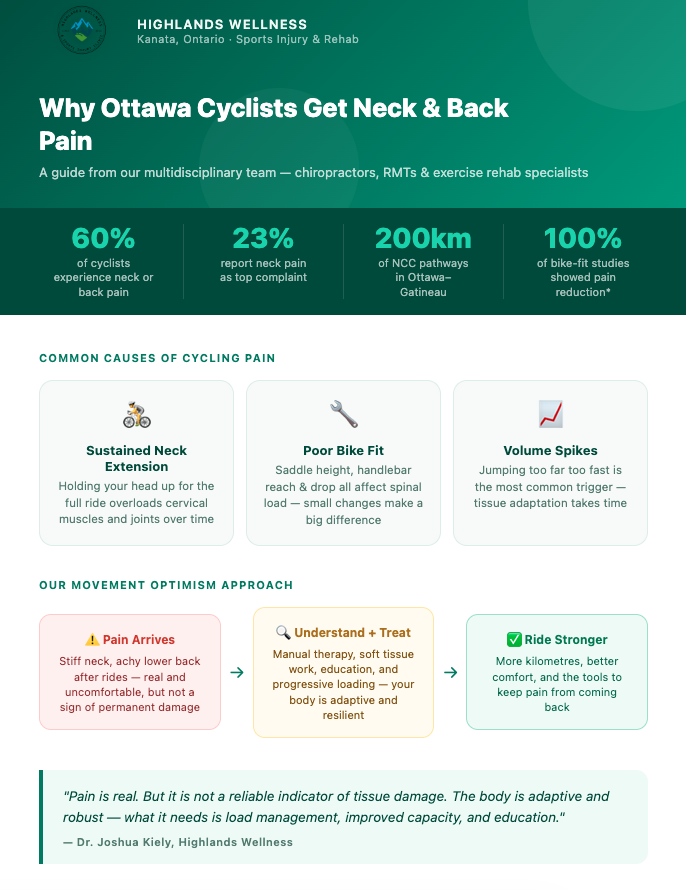
You're not alone. Studies show that up to 60% of cyclists experience neck or back pain at some point, making it one of the most common issues riders face. The good news? This kind of pain is not a signal that something is broken or worn out. Your body is more resilient than that. With the right understanding and a little support, most cyclists get back to riding comfortably, often feeling better on the bike than they did before.
At Highlands Wellness in Kanata, our team of chiropractors, registered massage therapists, and exercise rehabilitation specialists works with cyclists across the Ottawa region every summer season. Here is what we want you to know.
Why Cyclists Are So Prone to Neck and Back Pain
The cycling position puts your body into a sustained, non-neutral posture for extended periods. Your hips are flexed, your lumbar spine rounds, and your neck is in constant extension so you can see where you are going. For short rides, this is no problem at all. But as duration and frequency increase, the tissues involved — muscles, joints, discs, and nerves — can start to protest.
A 2019 research study found that 23% of cyclists reported neck pain and 22% reported lower back pain as their most common complaints. The cervical spine (your neck) works especially hard: in a typical riding position, your head weighs the equivalent of a bowling ball, and your neck muscles hold it extended for the entire ride. Over time, this repetitive loading without adequate recovery is what leads to that familiar stiffness and ache.
The key phrase there is repetitive loading without adequate recovery — not damage, not wear and tear, not anything permanent.
Pain Doesn't Mean Damage: A More Helpful Way to Think About This
One of the frameworks we embrace at Highlands Wellness is what physiotherapist and researcher Greg Lehman calls movement optimism. The idea is straightforward: pain is real, but it is not a reliable indicator of tissue damage. The body is adaptive and robust. Structures that feel "worn out" often just need load management, improved capacity, and education — not rest, avoidance, or fear.
For cyclists, this is freeing information. You don't need a perfect posture. You don't need to ride in a biomechanically "ideal" position at all times. What you need is a body that can handle the demands you're placing on it, and the knowledge to build toward that progressively.
This is why our approach at Highlands Wellness isn't just about treating pain in the moment. It's about building your capacity to ride more, ride harder, and feel better doing it.
How Highlands Wellness Supports Ottawa Cyclists
Our clinic brings together three complementary disciplines, which means your care is tailored rather than one-size-fits-all.
Chiropractic care addresses joint mobility in the spine and hips, which can become restricted with repetitive cycling. When your thoracic spine or hip joints aren't moving freely, other structures compensate — often the lower back and neck. Manual therapy helps restore that mobility so your whole kinetic chain works more efficiently.
Registered massage therapy (RMT) targets the muscular side of the equation. The trapezius, rhomboids, hip flexors, and thoracolumbar fascia all take significant load during cycling. Soft tissue work reduces tension, improves circulation, and helps your muscles recover between rides.
Exercise rehabilitation is where lasting change happens. Our exercise rehab specialists help cyclists build the endurance and strength in the deep stabilizers, glutes, and thoracic extensors that make the riding position sustainable. Think of it as training your body to hold the position, rather than just treating the fallout when it can't.
Practical Things You Can Do Right Now
You don't need to wait for an appointment to start feeling better. A few simple strategies that make a real difference for cyclists:
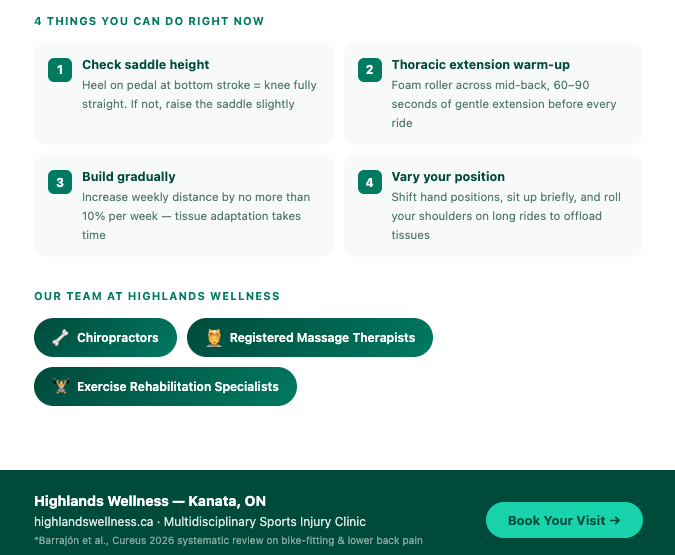
Check your saddle height by sitting on the bike and placing your heel on the pedal at the bottom of the stroke. Your knee should be fully extended. If it isn't, raise the saddle slightly.
Add thoracic extension to your warm-up — a foam roller placed perpendicular to your spine and a few gentle extensions over it for 60 to 90 seconds helps counteract the rounded position of cycling before you even clip in.
Build gradually — the most common cause of cycling pain isn't a bad position, it's a sudden spike in volume or intensity. The "10% rule" (don't increase your weekly distance by more than 10% in a given week) exists for a reason.
Vary your position on longer rides by shifting your hands, sitting up briefly, or doing some shoulder rolls. Small micro-breaks in posture offload tissue that's been under sustained stress.
You Should Be Riding Comfortably — Let's Get You There
Neck and back pain during or after cycling is common, but it's also very treatable. Most cyclists who come to us at Highlands Wellness leave with a clear understanding of why their pain is happening, a hands-on treatment plan to address it, and the tools to keep it from coming back.
If you're riding the NCC pathways through the Kanata area this summer and you're battling neck stiffness, lower back aching, or that nagging feeling that something isn't right — come see us. We'd love to help.
Book an appointment at Highlands Wellness in Kanata — we offer chiropractic, RMT, and exercise rehabilitation under one roof, so your whole body gets the support it needs.
📍 Kanata, Ontario 🌐 highlandswellness.ca
